Municipal testing yard · single player · free
Chaos Lab top-down survival shooter
A free single-player top-down survival shooter for Windows. Survive an industrial arena, switch between four weapons and combine perks that make bullets bounce, pierce enemies and seek targets. Short runs, caricature voices and laboratory chaos.
— recorded downloads.
Portable archive, no installer, nothing written outside your settings file. The build is unsigned, so Windows SmartScreen will warn about it — the build page says exactly what it does and does not do.
Specimen record
- Version
- 0.5.0
- Platform
- Windows 10/11, 64-bit
- Engine
- Godot 4.7.1, GL Compatibility
- Package
- Portable .zip, one executable
- Price
- Free
- Languages
- English, Russian (F2 switches mid-run)
- Network
- Optional update check; offline play
- Accounts
- None
The archive is published at
/downloads/ChaosLab-0.5.0-windows-x64.zip. If that link returns a not-found
page, the build for this version has not been uploaded yet.
New in 0.5.0 — chaos with fewer popups
The first player feedback prompted a rethink of the opening minute and upgrade choices.
- Compact perk cards: choose with Z/X/C while combat continues. Each selection leaves 20 seconds before another offer; earned choices remain queued.
- A gentler first minute: slower enemies and a gradual crowd buildup. Levels arrive less often and perk descriptions are shorter.
- Weapons and ammo sit at the bottom center. Empty weapons are highlighted; key 4 selects the ammunition-free crowbar.
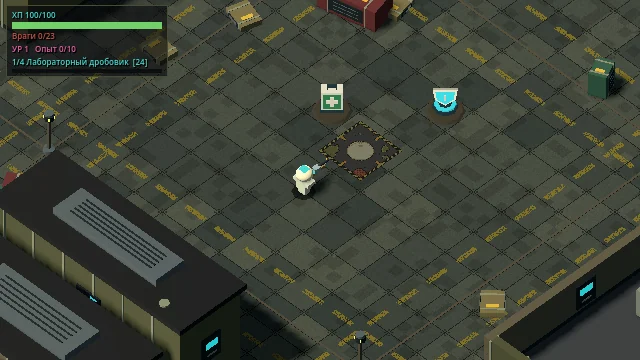
- New animations for all four weapons, casings and smoke, damageable monitors and panels. Russian voices react to events with fewer repeats.
Where this project actually is
Chaos Lab is an early single-player prototype. Version 0.5.0 revises perk choices, the opening minute and the weapon bar, with new animations and arena reactions. Animation and balance are still evolving.
No vote has opened
Season 1's three candidates have passed the gate and ship inside the build, but no voting round has been run and no launch date has been announced.
No results to show
Nothing has entered the game by community vote, so the archive lists what shipped and who wrote it, and stops there.
No payments
No subscription, storefront or donation channel is open. This site sells nothing, sets no cookies. Visits and downloads are counted in aggregate.
What you actually do
You walk into an endless municipal town with a shotgun, a crowbar, a nailer and a flare gun. Clerks, technicians and inspectors come to meet you. Every level-up offers three perks, and the interesting ones do not make you stronger — they make your bullets behave strangely, often at your own expense. Pellets that come back. Blasts that catch their owner. Children that split again.
Then you die, usually to something you built yourself, and the Incident Report names the cause, prints an award for whatever you did most stupidly, and lists the perks you were carrying. Restarting is immediate.
Weapons
Lab Shotgun, Municipal Crowbar, Regulation Nailer, Compliance Flare. Ammunition is finite and lies around the town in crates.
Crowd
Filing Clerks are fast and fragile, Lab Technicians balanced, Site Inspectors slow and heavy. You tell them apart by headgear, because that is what the camera can see.
Thirteen perks
Ten of them rewrite projectile behaviour and stack with each other, which is where runs stop being predictable.
Town, not arena
Seeded blocks that build and discard themselves as you move, with buildings you can enter and one-off repair and shield stations worth the walk.
A dash worth having
Space makes you briefly untouchable. Most deaths are still your own fault.
Incident Report
Session statistics, a death cause that names what killed you, and six possible awards including Own Worst Enemy.
Colour is the mechanic
A projectile's colour comes from what it is currently doing, never from the perk that made it do that. Stack four perks and you get a colour you have not seen before, which is the point: the screen has to stay readable while a hundred enemies are on it.
- Player, ivory with a cyan visor
- Enemies, brick red
- Ordinary and homing pellets
- Explosions and hazard markings
- Burning and recursive children
- Anything that can hurt you
- Aged concrete infrastructure
- Dirty olive municipal fittings
The game renders at a logical 640 × 360 through a fixed isometric camera — about twenty pixels to a world unit — so legibility is a matter of pixels rather than polygons.
The season cycle
Four weeks, repeating. The order is the whole design: perks are played before they are voted on, never pitched and then built.
- Week 1 — Trial. Three gated candidate perks are live in the game, playable and temporary.
- Week 2 — Vote. The three switch off. A week of absence is what makes the vote a decision rather than a formality.
- Weeks 3–4 — Settled. The winner joins the permanent rotation, and the next three candidates are generated and gated during the quiet stretch.
The build carries the schedule as data and derives the phase from the date, so a season turns over without shipping two builds a week. A copy that is never updated can still tell it has run out of season — the schedule knows the date its own cycle ends, offline.
The vote page lists Season 1's candidates and says exactly what state the round is in.
How a perk gets in
- Propose. A locally run language model turns a one-line idea into a candidate resource. Generation happens during development; the model writes data, never code — a perk has no field in which code could go.
- Import. A whitelist, not a reader. An unknown lever name is refused rather than mapped to zero, an out-of-range value fails in a second, and duplicate identifiers are checked against the shipped catalog.
- Gate. Schema, values, then a headless run with the perk stacked to its limit. The verdict rests on counted work — projectiles requested, pool occupancy, the share the safety layer refused — so it is the same on any machine.
- Trial, then vote. Survivors ship, live for a week, and switch off before anyone votes on them.
Two rules that will not change
Money buys influence over content, never power in play
No purchasable advantage and no supporter-only perks in a build other people play. The game is single player, which makes this easy to hold — which is exactly why it is written down now, before it is inconvenient.
Voting decides what is added, never what is removed
Otherwise every balance complaint becomes a purchasable outcome. A perk that loses a season stays on disk and may win a later one.
A third rule is the developer's rather than the community's: content added by vote is still content the developer is responsible for, and a perk that wins and then proves broken must be removable.
What the game and this site send
The game can ask a server once at startup whether a newer build exists. It is a plain GET of a small static file: no identifiers, no query string, nothing about you. It never blocks startup, fails silently when there is no network, and downloads and installs nothing — at most it shows a button on the title screen that opens a link in your browser. It checks only https://chaoslabgame.ru/updates/latest.json and can be disabled in your settings file.
This site uses an aggregate download counter and cookie-free 3check analytics. No accounts or payments. The update manifest is documented on the build page.
Feedback and suggestions
Found a bug, dreamed up a perk, or want to share your impressions? Send us a message on Telegram.
Before your first run
How do I download and launch Chaos Lab?
Visit the Windows download page, extract the ZIP and run ChaosLab.exe on 64-bit Windows 10 or 11. The game is free and needs no account or installer.
Can I play offline?
Yes. Runs are single-player and work offline. The optional update check can be disabled in settings.
What do weapon perks change?
Ricochets, piercing and homing alter actual projectile behavior and combine with other effects. Browse the perk catalog. Choose with Z/X/C while combat continues; switch weapons with 1–4.
Is it similar to Crimsonland?
The shared starting point is top-down shooting, crowds and arena survival. Chaos Lab focuses on an industrial laboratory, caricature voices and combinations of bullet effects. It is an independent early prototype, not a Crimsonland sequel.
See updates and development screenshots for the changes so far.